
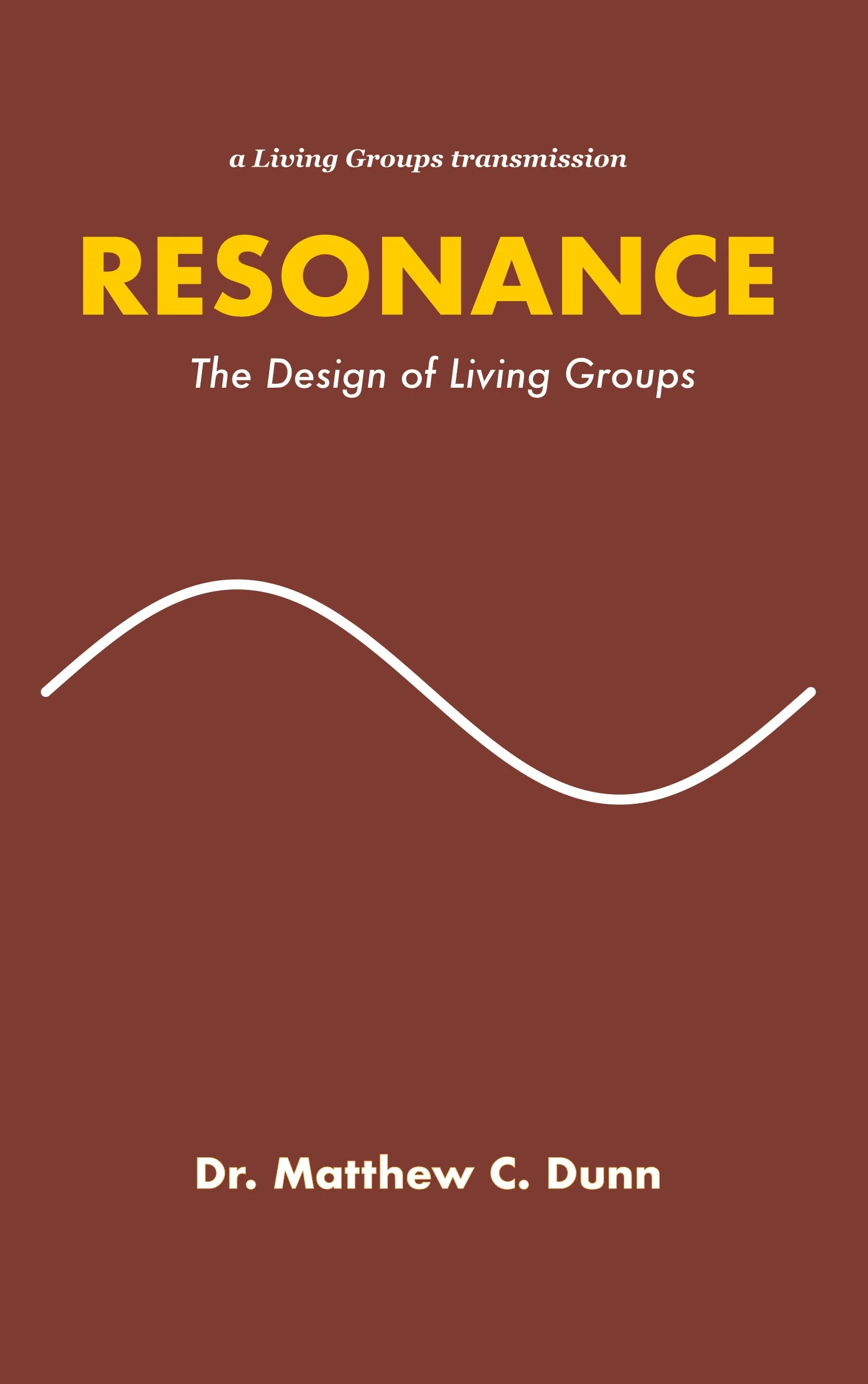
RESONANCE
The Design of Living Groups
What This Is
Groups are alive. They breathe, pulse, complete. When these patterns flow, the group regenerates the humans inside it. When violated, the group extracts from them, and everyone exhausts.
MOVEMENTS proves the patterns must exist. ATTUNEMENT trains you to perceive them. RESONANCE offers the axiomatic grammar for designing from them.
Not techniques. Not best practices. A rigorous design philosophy grounded in one question: what would you build if you genuinely loved the people inside it?
Love as design constraint, named with the rigor of axiomatic design theory. Two axioms from which the entire architecture of the book derives: honor the oscillations, and the human is the unit. From these, the book generates the diagnostic for coupling — the design move by which extraction hides inside good intentions — and the refusal of that coupling as the work of love in organizational form.
Who This Serves
This book serves:
Designers, leaders, culture builders, organizational architects
Anyone responsible for the structures inside which other humans work
Practitioners who have perceived the patterns and want to design from them
Leaders asking: what would I build if I genuinely loved the people inside it?
Those who sense that extraction lives inside their good intentions and want the architectural language to see itYou already feel these patterns. This trains you to trust what you detect, articulate what you sense, validate what bodies know. Systematic phenomenology—not "trust your gut" mysticism but rigorous research methodology.
You have already felt what extraction does to bodies. This gives you the structural vocabulary to recognize where extraction lives in the designs you are responsible for — and the axiomatic discipline to design differently.
What You'll Encounter
Love as Design Constraint — The reframe. Love is not soft. Love is the most rigorous design constraint available. Harder to satisfy than efficiency. Less forgiving than productivity.
The Two Axioms
Axiom 1: Honor the oscillations
Axiom 2: The human is the unit
The Three Movements as Design Axioms — BREATH, PULSE, TIDE rendered not as descriptions but as generative constraints that love structurally requires.
The Coupling Diagnostic — The independence axiom violation. How one design decision trying to satisfy multiple functional requirements is the architecture extraction uses to hide inside good intentions. The alibi coupling, where love language becomes cover for depletion.
The 108 Koans — Field observations in compressed form. The oracular body of the transmission, curated into the book and available in full as the companion deck.
How This Connects
RESONANCE is the third work in the Living Groups trilogy. MOVEMENTS proves the patterns must exist. ATTUNEMENT trains systematic perception of them. RESONANCE offers the axiomatic grammar for designing from them.
Read this before:
Engaging Leadership in Motion — if you want the theoretical foundation before the cohort-based practice
Returning to MOVEMENTS and ATTUNEMENT — if you want to design from love and work backwards to the foundation
Read this after:
MOVEMENTS — if you want proof of the patterns before learning to design from them
ATTUNEMENT — if you have trained perception and are ready to design from what you perceive
The Rhythm of Us — if you want accessible framework before axiomatic design
Or start here if:
You are a designer, leader, or culture builder ready to design from love as structural constraint
You have already perceived where extraction lives in your work and want the vocabulary to name and refuse it
You want to begin with the forward question before studying the foundation backwards
Related Koans
“The meeting is the disease”
“Your tiredness has ancestors.”
“One decision. One requirement. anything else is coupling.”
Get This Book
Published: 2026
Publisher: Fractal Praxis Press
Format: Softcover